Close your eyes and recall a joyful food memory. What aromas fill your mind? Does your mouth water thinking of a cherished dish? Perhaps your heart quickens with the memory of shared laughter and companionship. If you attend a class led by Second Harvest of Silicon Valley’s Community Nutrition team, you might be prompted with these leading questions that provoke thoughtful engagement and curiosity around food.
Food’s role extends far beyond our physical needs; it’s a powerful link to our pasts, our cultures and the love we share. We gather around tables, inviting others into our homes, offering meals as symbols of care and connection. Our relationship with food is deeply personal, shaped by cultural heritage, family traditions, childhood experiences of abundance or scarcity, self-perception and emotional landscapes.
Yet often traditional nutrition education prioritizes general information and strict guidance over empathy and understanding, overlooking the profound emotional and cultural connections individuals have with food. We’ve witnessed this firsthand in our nutrition education classes and cooking demonstrations. Clients express guilt over enjoying their cultural foods, attributing health conditions to perceived lack of discipline. Others struggle to maintain consistent eating habits due to demanding schedules that interfere with cooking and meal planning.
Our nutrition education work, aligned with Second Harvest’s mission to end hunger in our community, has evolved to address these complexities. We’ve shifted from simply providing information to empowering clients to confidently prepare and enjoy the food available to them. Through active listening, we’ve identified key factors influencing their food choices: preserving cultural traditions, acknowledging past trauma, and providing tools to cope with daily stressors like resource scarcity, time constraints and family dynamics. This client-centered approach, recognizing the deeply personal nature of food, has prompted us to develop a holistic framework to support their nutritional well-being, moving beyond mere instruction to genuine understanding and empowerment.
Second Harvest’s Nutrition Education Framework
Pillar I: Culture-centered

At the heart of our community nutrition education lies a deep respect for cultural gastronomy, whether it’s a quick chat while handing out a flyer or a deep conversation during a shared cooking experience. Across all our interactions, we’ve observed the strong connection our clients have to their cultures and a desire to maintain this heritage through cooking familiar dishes. Understanding this fundamental need, our nutrition team actively champions the voices of those with lived experiences, celebrating their culture and traditional foodways by gathering their stories and cherished recipes. Our growing nutrition center proudly features over 100 culturally rich recipes from the families of partners, clients, volunteers and staff, all featuring ingredients readily available at our food distributions. This collection of recipes demonstrates that cultural dishes and healthy eating are not only compatible but thrive together when we embrace the diversity of all traditional foods, including beloved treats!
Every interaction, big or small, strengthens our connection with our clients. Our cooking classes and demonstrations are vibrant celebrations of cultural recipes. A recent highlight was a nutrition series for farmworkers in Half Moon Bay, where the shared act of cooking and eating Mexican dishes – from refreshing ceviche to comforting atole – created a space of nourishment and belonging. These experiences emphasize the vital importance of cultural sensitivity when engaging with the community, ensuring clients feel seen, valued and truly integrated into the class.
A recent Half Moon Bay farmworker who participated in a nutrition education workshop in November 2024 shared, “I’m from Nayarit, I miss my family and the food there. I don’t have a lot of time to cook here, so many times I just eat quick ready to eat meals. Today we wanted to make ceviche and shrimp a la Diabla because it reminds us of our hometown, our families and our friends and in a way, it helps us feel closer to home.”
Pillar II: Trauma-Informed Practices
We understand that diet behaviors or health outcomes could be a result of stress and trauma from adverse childhood experiences (ACES) which can make it difficult to adopt healthy eating habits. Our trauma-informed approach recognizes the impact of trauma on the body and mind and works toward building protective and healing factors that include thoughtful conversations around food. We offer presentations on fostering a healthy relationship with food along with ongoing training for our nutrition volunteers, providing them with tools to show up with empathy, compassion and understanding for our clients.
A Vela Apartment resident who participated in a nutrition education workshop shared, “I was homeless for seven years and now I find it difficult to be indoors, so to keep myself in the house I cook a lot for others. Many times, I don’t eat what I cook, I prefer to share it. I’m very grateful to have a home, but it is difficult to adapt.”
Our community work is driven by a commitment to learn directly from our clients. By actively listening to our clients, we gain crucial insights that shape our programs, materials and recipes to better meet their needs. In our classes, we create a safe and judgment-free environment where “everything is an invitation,” encouraging clients to share their experiences and confidently express themselves. This process of self-inquiry helps them understand how to nourish their bodies and make informed choices about foods that can promote positive health outcomes.
“This recipe was so simple and doesn’t taste like I’m forcing myself to eat healthy, you know what I mean. Makes me feel good knowing I am eating healthy even though I don’t have a home,” commented a Safe Harbor resident after trying a sample from our cooking demonstration.
Our cooking demonstrations are interactive, involving clients in discussions about ingredients and encouraging personalized swaps. We’ve learned firsthand that food can be a source of trauma. For instance, a client’s strong aversion to an ingredient in a popular recipe came from a negative childhood experience of being constantly forced to eat it. Such experiences highlight the critical importance of approaching all community interactions with empathy and compassion, recognizing the many factors that influence someone’s behavior around food.
Pillar III: Integrative-Focus
We believe that nutrition education is most effective when it is integrated with other initiatives that can influence health and wellness. We offer a blend of interactive nutrition workshops and classes that provide clients with the support they need based on their desired outcomes – such as finding joy in cooking with food bank staples or learning ways to cope with daily stressors. Some examples of these classes are intuitive cooking, mindful eating, journaling and self-reflection, and intelligent movement and breathing. This whole-person approach provides our clients with tools to foster resilience, and coupled with providing nutritious foods, it’s a start to the path of healing.
We consistently hear from our clients about the various obstacles preventing them from eating nutritious meals to reach their health goals. Their stories reveal a range of circumstances – from homelessness and addiction recovery to the demands of single parenthood and limited resources. Despite their diverse backgrounds, food insecurity and the constant pressures of daily life are recurring themes. In response to these challenges, we have implemented mindful movement classes, integrated breathing exercises into our nutrition curriculum, and facilitated discussions on the influence of emotions on food choices. By providing these accessible tools, our goal is to foster awareness of healthy stress management.
Our collaboration with Santa Clara Family Health Plan in 2024 exemplifies this integrative approach. We offered eight gentle yoga classes in San Jose, introducing participants to accessible movement, breathwork and adaptable poses over eight weeks. Post-program feedback confirmed the positive impact on well-being and the complementary nature of yoga to our nutrition education. These gentle movement classes were designed to nourish, restore and holistically enhance health, learning and enjoyment.
By integrating practices like breathing exercises and gentle movement, we provide clients with tangible tools to navigate toxic stress. This approach fosters body awareness, empowers informed food choices, and supports the creation of sustainable lifestyle plans through guided self-inquiry.
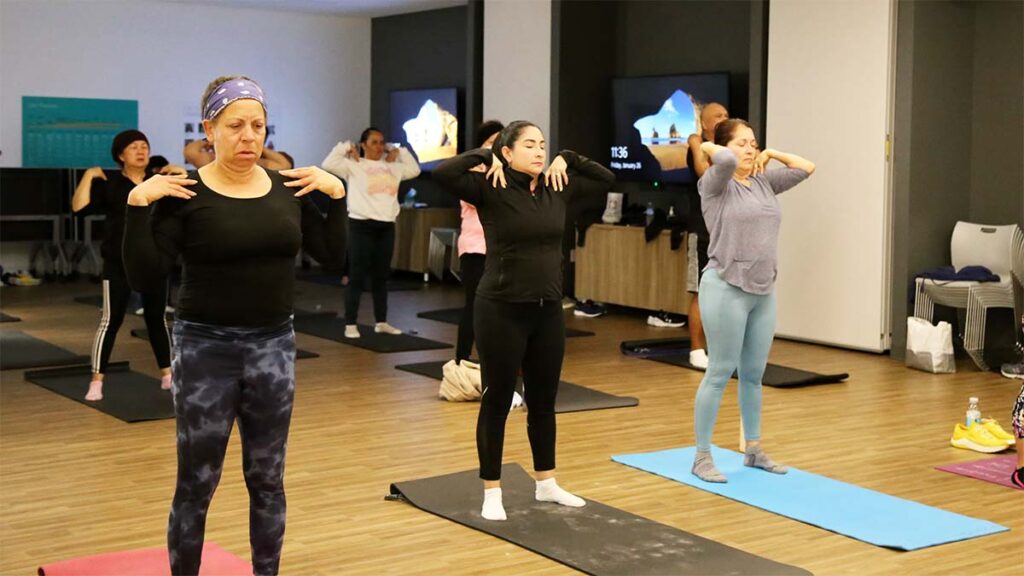
What participants said about the intelligent movement classes:
Question: What motivated you to attend these yoga classes, or to continue to attend?
- “Spending time with people in my community, mental health and for my body.”
- “I keep coming to these classes because I feel very relaxed afterwards.”
- “To do more for my body and my health.”
Question: Did your perception of yoga change after taking these classes? If yes, how?
- “Now I understand that anybody can practice yoga, it’s not just for some body types.”
- “Yes, it did. I thought yoga was just for rich people, but it is for everyone, and the movements can be practiced anywhere.”
Cultivating relationships with food that support well-being
Our work in the community has revealed an important truth: supporting our clients to achieve well-being extends beyond the communication of official dietary guidelines. While nutritional knowledge is foundational, it is insufficient to address the complex dynamics that profoundly influence our food choices. Food nourishes not only our bodies, but also our hearts and souls, linking us to cherished traditions and beloved memories and places in the world.
Our intention implementing this nutrition education framework in the community is to acknowledge the deeply personal nature of food. We also aim to cultivate health autonomy by fostering understanding, empathy and the practical tools to navigate the complexities of daily life.
We remain committed to continuing this work in the community, empowering clients to nourish themselves with confidence and ease, honor their unique experiences and cultivate a sustainable, joyful relationship with food that supports their overall well-being.