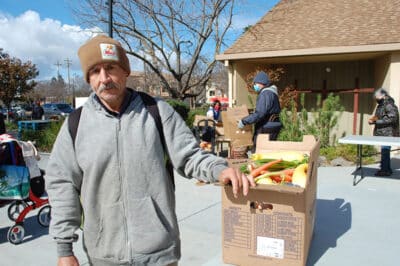
At Second Harvest of Silicon Valley, our work is grounded in the belief that access to nutritious food is the foundation of good health — not just in the short term, but over a lifetime. Food insecurity takes a toll on physical, mental and emotional well-being, and is linked to higher risks of chronic conditions like diabetes, obesity, heart disease and mental health disorders.
Recognizing that food is medicine, Second Harvest began partnering with medical providers in 2009 to address the critical connection between nutrition and health. We are proud to partner with world-class healthcare providers like Stanford Health, who share this vision. Stanford Health has long been working with Second Harvest in addressing food insecurity to improve health outcomes.
Nutritious food is particularly important for children, supporting brain development, healthy growth, immunity and more.
“When we think about children’s health, having nutritious food is the baseline,” said Baraka Floyd, MD, MSc, Stanford School of Medicine. “Not having enough nutritious food can increase your risk for mental health conditions. It can increase your risk for poor school performance. It can increase your risk of dropping out of school. It can increase your risk for anemia, poor asthma control, hospitalization, and the list goes on and on.”

Why Food Insecurity Screening Is Essential for Better Patient Care and Recovery
Food insecurity doesn’t just affect a person’s access to food — it affects their ability to heal, to manage their health and to live with dignity.
“When you think about particular disease states, food insecurity increases your risk for poor diabetes control, for diabetic ketoacidosis, for kidney disease and more,” Dr. Floyd explained. “And if patients don’t have food and they have an important surgery and they’re not having the nutrition afterwards, they’re going to have a worse outcome.”
That’s why medical partnerships like this are so important. Working together, we’re integrating food insecurity screenings into the health care system — incorporating food insecurity screening into standard patient intake procedures and then connecting patients to resources when they screen positive. This fills an important need for healthcare providers and helps patients get the nourishment they need to support better outcomes.
Broadening the reach of food insecurity screenings
Stanford medical professionals in the Office of Child Health Equity have partnered with Second Harvest for many years. Dr. Floyd, who works both at Stanford Medicine and Gardner Health Services, another Second Harvest medical partner, started running our food insecurity screening program in the Children’s Hospital around 2016. “For me it’s been a matter of, this needs to happen,” she explained. “There was no way that I was not going to do this.”
“We have really seen the need for access to nutritious food in our community and recognize how much of an impact it can have on the patients we serve. We knew that we needed to do something,” said Lindsay Stevens, MD. “For me, it was just a matter of understanding how complex this issue is and how many people we need to pull in to make sure it’s successful.”
The work to broaden the program’s reach began around 2019. As a clinical informaticist, Dr. Stevens works on leveraging technology to improve healthcare delivery and improving our understanding of health through this data. “In 2019, we began trying to figure out if there was an IT solution for the screening process to make it visible to clinicians so that patients aren’t screened too frequently, and that if they are screened, that information is visible — not hidden in a note somewhere.”
“This has been a very long labor of love for us to try and figure out how to do this in a system as big as ours,” she said.
Partnering to Improve Patient Health Through Food Access
One patient at a time, access to nutritious food improves community health as a whole. How? Dr. Floyd shared an example.
“One of the areas we’d think about is obesity,” she explained. “One of the key ways obesity is a social issue is by not having access to nutritious food. Being able to help families with access to fruits and vegetables and things that they’re able to choose that are healthy is one of the key ways that we can prevent obesity, heart disease, diabetes, et cetera, for children in the future.”
In addition to vital nourishment, when patients receive a referral from their doctor, dietitian or social worker to Second Harvest for food, it can provide a sense of comfort and support.
“Patients are busy, they’re stressed, they may not know what resources are available or feel overwhelmed,” explained Dr. Stevens. “It’s huge for people to feel like they have a connection to a resource and they know where to go and they don’t have to think through all the steps that they need to do to get what they need — some of that worry is taken away.”
Nutritious food availability improves community health one family at a time
“It’s extremely empowering for our providers to be able to address a need in the moment,” said Dr. Floyd. “There’s almost a sense of moral distress at the end of a visit when you’re not sure whether or not a family is going to be able to follow through just because our systems are so complicated and aren’t really set up in a way that are easy to navigate. So it’s very reassuring … I know that they’ll be contacted by Second Harvest.”
Providers across Santa Clara and San Mateo counties are referring more and more patients to Second Harvest. In fiscal year 2021, providers referred 765 patients to us and by fiscal year 2025, that number grew to nearly 2,300.
This important work is only possible thanks to incredible partners like Stanford Medicine, grants and the generosity of our donors. Together, we’re providing access to nourishing food that can transform community health — one patient, one family and one partnership at a time.